

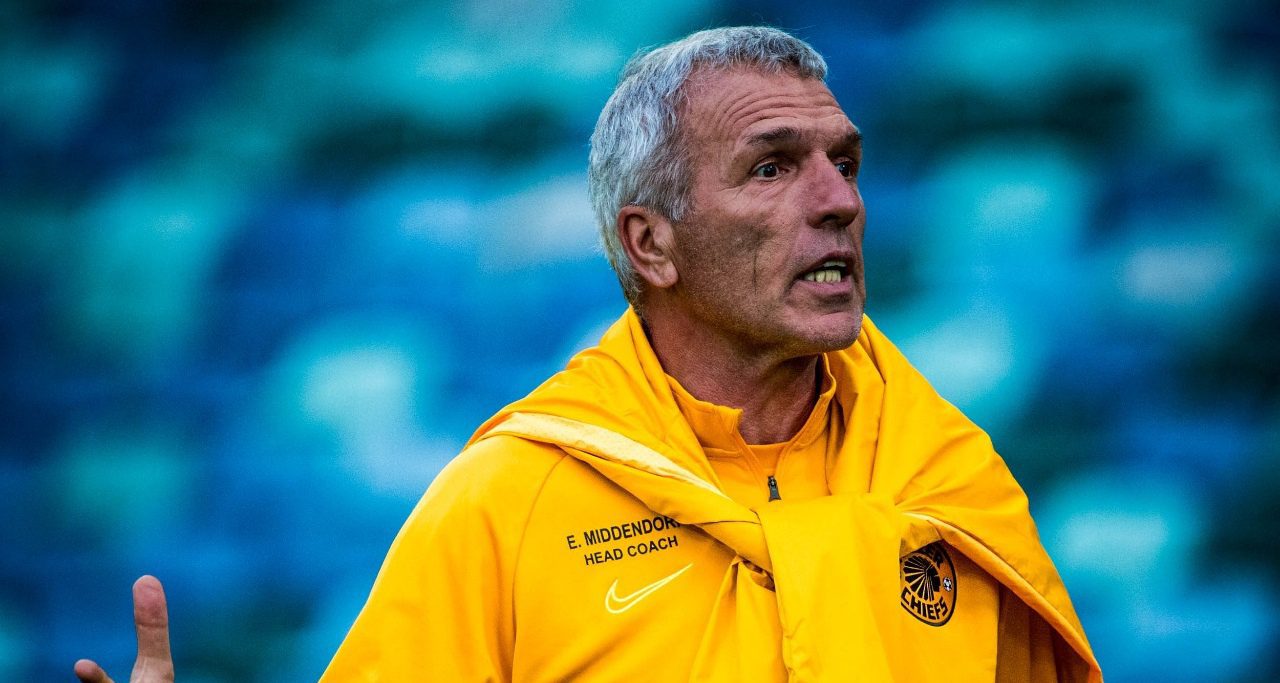
Ernst Middendorp has provided a candid look into the complexities of coaching Kaizer Chiefs, describing the club as a “monster” demanding a unique approach, while highlighting the key factors necessary to survive and succeed at Naturena.
The Glamour Boys have dominated the headlines over the past few months, primarily due to the club’s dismal form under co-coaches Khalil Ben Youssef and Cedric Kaze.
Amakhosi are currently enduring a dismal run of four successive defeats across all competitions. The Soweto giants stumbled in three league outings against Stellenbosch FC, Orlando Pirates, and Richards Bay FC, followed by a defeat to Zamalek SC, which saw them eliminated from the CAF Confederation Cup in the group stages.
These recent struggles have heaped immense pressure on the technical team, with disgruntled supporters calling for their immediate dismissal. This past weekend, the frustration boiled over as a group of fans marched to the Kaizer Chiefs Village in Naturena to hand over a memorandum demanding the firing of both Ben Youssef and Kaze.
The duo assumed the co-coaching reins in September 2025 following the departure of Nasreddine Nabi. Having initially arrived as assistants to the Tunisian mentor last season, they remained at the club to steer the ship on an interim basis for the remainder of the current campaign.
But with the current coaches seemingly skating on thin ice, Ernst Middendorp has taken the opportunity to detail what it truly takes to succeed at the Naturena-based outfit.
MIDDENDORP REVEALS WHAT IT TAKES TO SUCCEED AS A COACH AT CHIEFS
The veteran tactician enjoyed two separate spells at Naturena, first between 2005 and 2007, and later from late 2018 until the conclusion of the 2019/20 campaign. It was during that second stint that he came agonisingly close to league glory, only to see the title slip away to Mamelodi Sundowns on the final day of the season.
While his first season in 2005/06 yielded silverware in the form of the Absa Cup [now Nedbank Cup] and the 2006 SAA Supa 8 [MTN8].

Under Middendorp, Chiefs utilised a direct, result-oriented brand of football that maximised the squad’s potential. The German mentor maintains that understanding player strengths and limitations is paramount to finding success at a club of this magnitude.
“Anyone who wants to coach this team must understand the magnitude of the Naturena environment. The club carries an enormous history, a massive supporter base across the country, constant media attention, and permanent pressure for results. Every decision is discussed publicly; every weakness is quickly and totally exposed,” Middendorp shared via LinkedIn.
“To operate in such an environment, a coach needs real expertise, emotional resilience, strong leadership, and unbeatable confidence. He must have the ability to remain calm under pressure, show conviction in his work, and make decisions with authority. A certain stubbornness in a positive sense is evident, the courage to stand by your football ideas when the noise around the team becomes overwhelming.
“One of the key responsibilities of the coach is to identify the real capacity of each player. What can they truly deliver? What are their strengths, limitations, and consistency levels? Only when this assessment is done honestly can the coach build the most suitable structure and tactical set-up for the team.
“This means coaching is not about following dreams, wishes, or public expectations. It is about working with reality. The team structure must come from the individual capacities of the players available, not from theoretical ideas that do not match the squad.”
MIDDENDORP EMPHASISE THE IMPORTANCE OF PROTECTING PLAYERS’ WEAKNESSES
He added: ‘Even innovative concepts can emerge from this process. In certain situations, a “helicopter concept” or other unconventional structures may develop simply because the coach has carefully analysed the players and tries to organise them in a way that maximises their strengths and protects their weaknesses.
“At a club like Kaizer Chiefs, coaching leadership means clear assessment, courage in decision-making, and building a structure that reflects the real capacity of the squad, not an illusion of what people would like to see.”
RELATED STORY: Why Ernst Middendorp said no to the AmaZulu job