


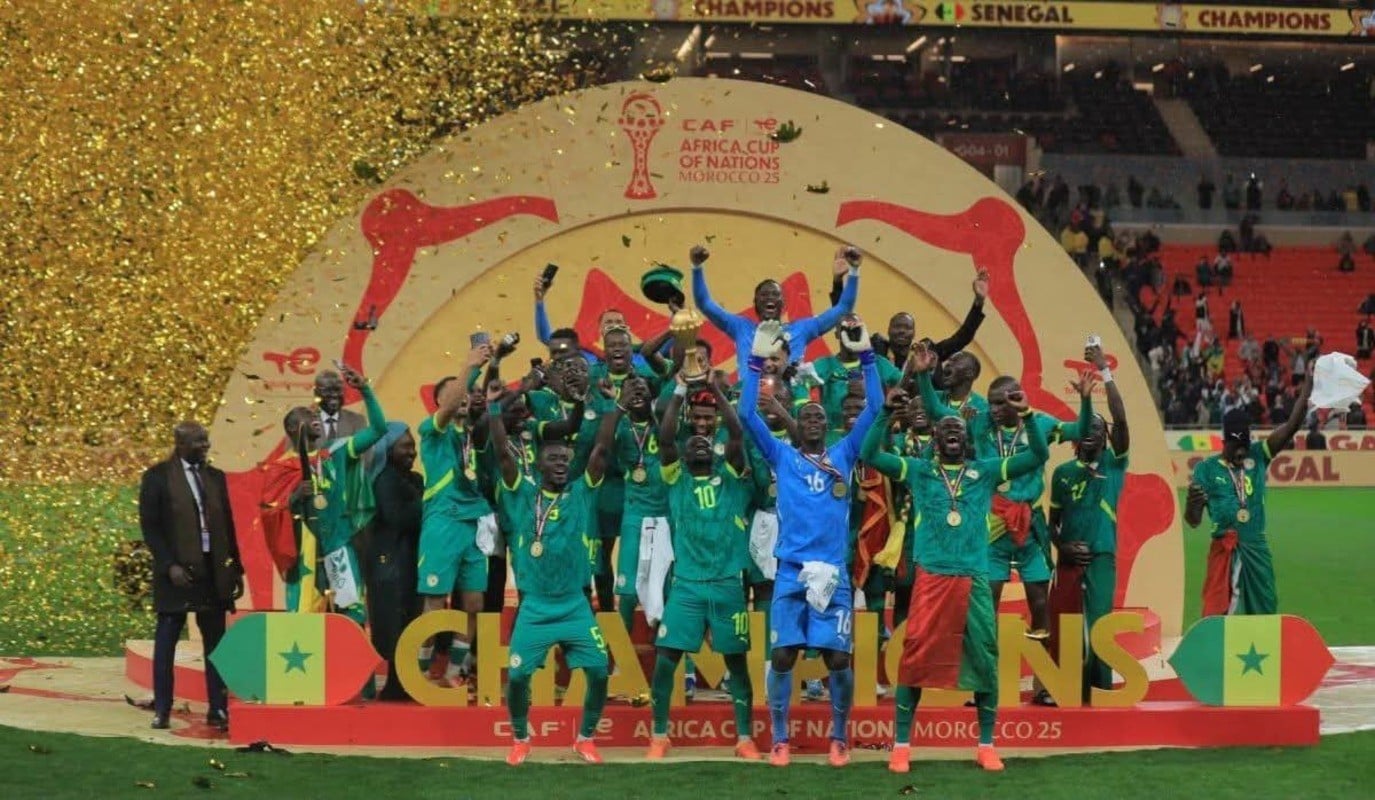
The 10-month boardroom battle over the 2025 Africa Cup of Nations [AFCON] trophy is officially over, with the Court of Arbitration for Sport [CAS] reinstating Senegal as champions and overturning an earlier Confederation of African Football [CAF] ruling that had awarded the title to hosts Morocco.
In a decision issued on Tuesday, 24 November, the Lausanne-based tribunal upheld the appeal lodged by the Senegalese Football Federation [FSF] against CAF and the Royal Moroccan Football Federation [FRMF], restoring the Teranga Lions’ 1-0 extra-time triumph from January’s chaotic final.
Senegal had originally lifted the continental crown on the pitch, only to see the trophy stripped away in March when a CAF Appeal Board ruled that their second-half stoppage-time walk-off—staged in protest against a late penalty awarded to Morocco—breached tournament regulations, handing the Atlas Lions a 3-0 default victory.
At the heart of the legal showdown in Lausanne was match referee Jean-Jacques Ngambo Ndala’s decision to allow the final to continue once Senegal returned to the turf after a 15-minute delay. Arguing before CAS, the FSF maintained that the Congolese official’s decision to restart play in the 109th minute [90+19] and see the match through to a sporting conclusion was protected by the ‘field of play’ doctrine and could not be undone in the boardroom.
HOW THE ‘FIELD OF PLAY’ DOCTRINE SAVED SENEGAL’S TITLE
The FRMF countered that the doctrine did not shield Senegal from the disciplinary consequences of abandoning the pitch, insisting that Ndala had acted arbitrarily and erred in law by resuming the contest.
CAS, however, sided squarely with Senegal and the match official, ruling that Articles 82 and 84 of the AFCON Regulations—which enforce forfeiture when a team refuses to play—only apply when a team’s conduct forces the referee to abandon a match permanently.
“After having examined the arguments raised by the Parties, the Arbitral Panel considered that the Referee’s decision to resume the match or to stop it fell definitively within his sole authority,” the CAS Arbitral Panel stated.
“By blowing his whistle to restart play, the Referee considered that the conditions for resuming the match had been met – both teams were on the pitch again, and both expressed their willingness to resume. In the Panel’s view, there is no doubt that the effects of the Referee’s decision were limited to the pitch.
“As such, the Panel considers that the Referee’s decision was covered by the ‘field of play’ doctrine. Since Articles 82 and 84 of the AFCON Regulations are intended solely to determine the outcome of a match when a team’s conduct leads the referee to call off the game permanently, they are therefore not applicable in this case. In conclusion, the Panel considers that in resuming the match, the Referee did not err in law.”
FROM RABAT CHAOS TO LAUSANNE REDEMPTION
The ruling brings closure to one of the most controversial finals in African football history. With the score locked at 0-0 in the dying seconds of regulation time in January, Senegal’s players stormed off the pitch following Ndala’s penalty call, sparking violent scenes in the stands and a lengthy stoppage.
Once order was restored and play resumed in the 109th minute, Morocco and Real Madrid forward Brahim Díaz saw his spot-kick saved before Senegal netted the winner in extra time via Pape Gueye—a result that now stands permanently in the record books after CAS set aside the CAF Appeal Board ruling and reinstated the CAF Disciplinary Board’s original verdict.
The ruling stems from a one-day hearing held in October, with CAS confirming that a comprehensive written judgment detailing the panel’s legal reasoning will be released in due course.
Although CAS verdicts can be taken to the Swiss Federal Tribunal, any potential appeal is limited strictly to narrow procedural matters rather than the sporting merits of the case.
RELATED STORY: Patrice Motsepe reacts to Senegal challenging CAF decision